And How it Spawned a Campfire Talk, then a Trilogy
By Campfire Park
Writing a book is hard enough ...
But not as hard as trying to co-author a trilogy.
It all started with a half-hour talk
Especially when all you set out to do was a half-hour campfire talk. The occasion: It was the run-up to the 100th birthday of America's National Parks. The venue: a remote campground in the heart of south Florida's Big Cypress Swamp. The result: About a dozen people showed up. That didn't stop up from doing the talk about a dozen times, and eventually writing a book, then a trilogy and now this website. Did I say we? Sometimes (actually most of the time) I wondered where Rudi was.
Lots of people talk about it, and some even give it an honest start, but finishing? Now that’s pretty rare. Even rarer still is co-writing a book, and here’s the clincher: writing two more to make it a trilogy. Not saying it’s perfect, but what masterpiece is. Most importantly it’s done … with the exception of the abridged version. Stay tuned!
Let’s just say one thing led to another, led to another, led to another until we were too deep in to turn around. By we, I mean Rudi and me. The year was 2014. We were around a campfire celebrating the 40th birthday of Big Cypress National Preserve. Looking back, that was the original campfire, our original campfire, and from which everything that came after took root. First our campfire talks where we went “old school” and ditched the Power Point that Ranger Rudi would have otherwise used had I not suggested we collaborate, just him, me and my guitar and a script that kept the audience guessing at every turn. The occasion was the 100th birthday of America’s national parks, rapidly approaching in 2016. Twelve campfire talks later, we’d done our job — with the caveat we wanted to do more. And so the idea for a book was born.
Eight months into writing the novel, which we tentatively entitled The Legend of Campfire Charlie, I informed Rudi that we had too much material, and that the only solution was to turn it into a trilogy. Thus, what started as a half-hour campfire talk turned into a 6-year writing odyssey. Not that I didn’t enjoy the process, I did. In fact, it was a diversion that kept my mind spinning, and helped me refine and expand my writing process. The first book we published in 2016 in time for the 100th birthday, if also not to much fanfare. Not that I cared. There were still two more books to write. By 2020 the trilogy was done, with a twist: the books needed a home. And so the idea for the Campfire Park website was born. Rudi and I were less interested in hawking the books than continuing the conversation around the campfire, just like the “original campfire” where the entire project came to life.
Spoiler alert: The trilogy is great, and I recommend all three books. But an abridged version of all three books is on the way. At the end of the day, even if it takes decade, I’d like to think and always want to be remembered as a finisher — somebody who set out to on a great journey and got to the finishing point.
Oh, and about the roll out of the soon-to-be-released abridged book. It should be just in time for the 50th Anniversary of Big Cypress National Preserve in November 2024. Actually, the abridged version should be out before then.
But over time its deeper meaning, and entertainment value starts to soak in. To cut to the chase, I’m talking about a book, and not just any old book, but a book that was part of a trilogy written by two park rangers named Robert V. Sobczak and Rudi Heinrich.Visit the trilogy’s webpage
The thing about this book:
They never set out to write a book, let alone a trilogy.
The trilogy was written from 2015 to 2020
Their simple goal:
A 30 minute campfire talk.
In action at the campfire talk
The rest, shall we say, is campfire legend.
Or more specifically, The Legend of Campfire Charlie.
It’s not only rereadable …
It’s a worthy addition on any bookshelf … in my opinion.
I don’t know much, but I’m inclined to spill whatever I do out at the campfire
Bob and Rudi collaborated on 12 campfire talks that led to writing the Centennial Campfire Trilogy: (1) The Legend of Campfire Charlie, (2) Last Stand at Boulder Ridge and (3) Final Campfire
Hindsight as we say is 20/20. The reason? We have the benefit of seeing how the future played out. We survived the past, so it must have been good, and so seeps in the “nostalgia effect.” But make no mistake, they were good times, too. At this campfire, Bob interviews Rudi about the ups and downs and many memories of his rangering days. Bob does his part by introducing a new “experimental s’mores” recipe that Rudi doesn’t seem to like much. It could have been intentional on Bob’s part knowing that if they were too good Rudi would have ate the entire stockpile.
The campfire is always crackling and visitors are always welcome at Campfire Park
Well, I think the same sort of applies to initial success.
Success too early in a process, or life, may feel good at the time, but can also be the kiss of death in the long run. Why? Success breads complacency in the same way failure inspires you to overcome.
My point is this:
Rudi and I co-wrote three books which, when we were done, inspired us to do a podcast. Both the books and the podcast were utter “initial” failures by traditional metrics. The silver lining was that I never lost faith. And it made me realize: Less about selling a product, the trilogy of books was the ultimate deep dive into exploring “big canvas” ideas that required 450,000 words of space and six years of time to properly spread out, metabolize and incubate in our minds. If you think writing a book, let alone a trilogy, is hard – try co-writing it with a Rudi! The mystery of the creative chemistry of our unlikely partnership became a reoccurring theme in the books. Our brief foray into a poorly-produced podcast (to discuss the books) was a dismal failure, too. Please listen to them and I think you’ll agree.
The second podcast
But all clouds have a silver linings:
The process, and those failures, was how the Nature Folk Movement (NFM) was born.
Thank God for failure – really it’s the only way we improve.
Well howdy folks, and I’m completely freaked out. And you know why. The fringe middle. The silent majority. Why are they so quiet?
If so, we highly recommend the Centennial Campfire Trilogy, all three books, either in kindle format or paperback. Personally, we recommend the paperback because for one you’ll be dog-earing many a page, referencing back and forth, and did we mention, they are awfully pretty tomes, either for your coffee table or bookshelf.
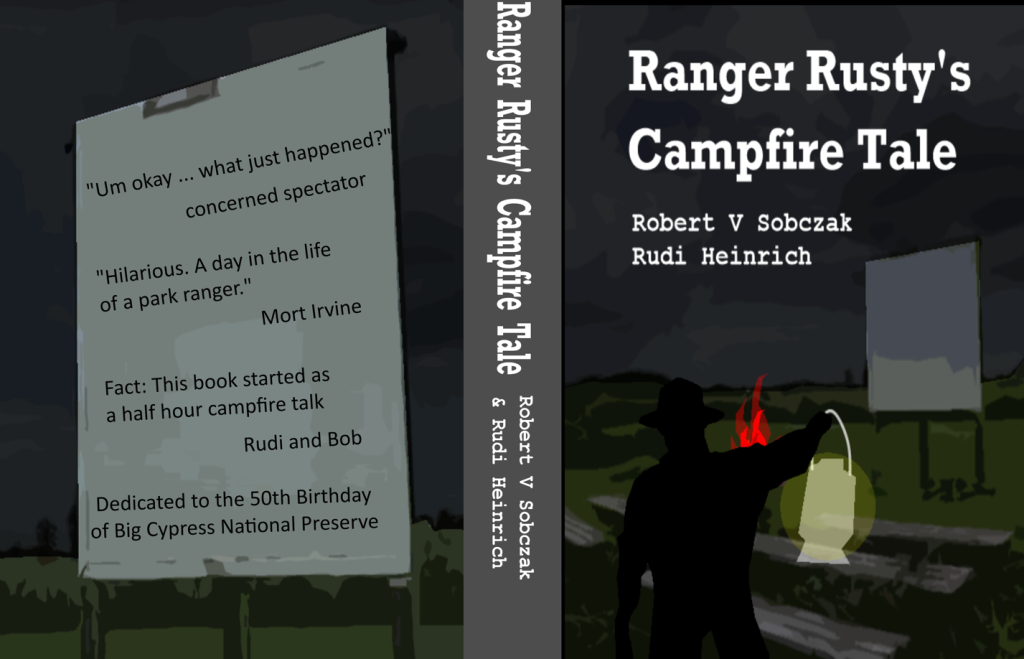
Welcome to Book 1 of the Centennial Campfire Trilogy. Do you have a fear of being squeezed to death by a giant Burmese Python? Or does being followed around all day by a Florida Panther rattle your nerves? If so, join Rusty, a well meaning but – how shall we say – “often distracted” park ranger who is scheduled to give an evening talk in a swamp preserve on a topic he doesn’t much like. Not to worry (or maybe worry a lot) as the unwitting ranger meets a mysterious stranger who catapults him on a breathtaking journey to confront and maybe finally answer the deepest and most confounding question of his life. That is assuming he can ever get done (or to) his campfire talk …
Book 2: Last Stand at Boulder Ridge
Watch the Book Review
Preview Book (click on image to see inside book)
Book Summary
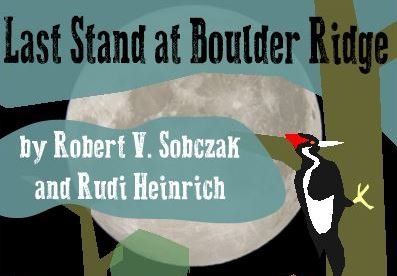
Welcome to Book 2 of the Centennial Campfire Trilogy. The saga continues! This time Ranger Rusty and his cohorts are off on a new adventure that leads them back and forth seamlessly in time and space to faraway places that include a Seminole War fort, the sands of the Middle East, the mountains of the Great Southwest, an archaeological expedition on the Mighty Joola River and airboat rides across the Everglades. Or is it all unfolding around the campfire glow in a remote nature reserve? We’ll let you be the judge.
Welcome to Book 3 and what critics are raving “the stunning conclusion” to the Centennial Campfire Trilogy. At the end of the first two books of the trilogy — The Legend of Campfire Charlie and Last Stand at Boulder Ridge — our fearless protagonist, Ranger Rusty, finds himself simultaneously trying to man the Sweetwater Visitor Center in the heart of the Big Cypress Swamp while also slipping back in time to distant childhood memories of an old backcountry camp and deeper still to a first-hand historical account of adventures at a Seminole War era fort and a haunted archeological dig for dinosaur bones as he tries to conjure the energy to hold court at a campfire talk in a remote campground at the end of a very (emphasis on very) long day. As exquisite an ending you’ll ever find in a “large canvas” epic work, Final Campfire is a full-body experience that no respectable book reader, plumber or campfire enthusiast (including the inner s’mores roaster in all of us) will want to miss.
The Cowboy at the Campfire provides a thought-provoking review of Book 2 of the Centennial Campfire Trilogy.
Buy the full trilogy of books, in kindle or paperback
Among his observations:
You’ll need a good book mark,
The book is part sequel and part prequel to the first book,
It’s a story of growth and idealism giving way to reality.
And spoiler report:
It sets the stage for the stunning cascade of conclusions Book 3.
The Centennial Campfire Trilogy by Robert V. Sobczak and Rudi Heinrich consists of three books: (1) The Legend of Campfire Charlie, (2) Last Stand at Boulder Ridge and (3) Final Campfire.
Why do I like most about the book?
To me, it’s a “rereadable” through a through. It’s the type of book you can pick up off your bookshelf and read front to back, or one chapter at a time, or even a few sentences. It is also what I call an immersive read. It takes you across the globe and deep back into time, to the point you can really get lost (in a good way).
As for my favorite scene?
It’s probably the campfire banter between Rusty and Kenny while in the desert overseas. Or maybe it’s Rusty’s airboat ride with his father? Or maybe his boyhood encounter with Edward Abbey? Or maybe it’s the journals of Col. Stanley Powell. Or maybe it’s the Bone Wars era archaeological dinosaur dig. Or maybe it’s even the prologue to the book.
 Bob and Rudi never set out to a book, let alone a trilogy. Their task as hand was much simpler: A 30-minute campfire talk to a dozen or two campers at a remote swamp campground. |