And How it Spawned a Campfire Talk, then a Trilogy
By Campfire Park
Writing a book is hard enough ...
But not as hard as trying to co-author a trilogy.
It all started with a half-hour talk
Especially when all you set out to do was a half-hour campfire talk. The occasion: It was the run-up to the 100th birthday of America's National Parks. The venue: a remote campground in the heart of south Florida's Big Cypress Swamp. The result: About a dozen people showed up. That didn't stop up from doing the talk about a dozen times, and eventually writing a book, then a trilogy and now this website. Did I say we? Sometimes (actually most of the time) I wondered where Rudi was.
Lots of people talk about it, and some even give it an honest start, but finishing? Now that’s pretty rare. Even rarer still is co-writing a book, and here’s the clincher: writing two more to make it a trilogy. Not saying it’s perfect, but what masterpiece is. Most importantly it’s done … with the exception of the abridged version. Stay tuned!
Let’s just say one thing led to another, led to another, led to another until we were too deep in to turn around. By we, I mean Rudi and me. The year was 2014. We were around a campfire celebrating the 40th birthday of Big Cypress National Preserve. Looking back, that was the original campfire, our original campfire, and from which everything that came after took root. First our campfire talks where we went “old school” and ditched the Power Point that Ranger Rudi would have otherwise used had I not suggested we collaborate, just him, me and my guitar and a script that kept the audience guessing at every turn. The occasion was the 100th birthday of America’s national parks, rapidly approaching in 2016. Twelve campfire talks later, we’d done our job — with the caveat we wanted to do more. And so the idea for a book was born.
Eight months into writing the novel, which we tentatively entitled The Legend of Campfire Charlie, I informed Rudi that we had too much material, and that the only solution was to turn it into a trilogy. Thus, what started as a half-hour campfire talk turned into a 6-year writing odyssey. Not that I didn’t enjoy the process, I did. In fact, it was a diversion that kept my mind spinning, and helped me refine and expand my writing process. The first book we published in 2016 in time for the 100th birthday, if also not to much fanfare. Not that I cared. There were still two more books to write. By 2020 the trilogy was done, with a twist: the books needed a home. And so the idea for the Campfire Park website was born. Rudi and I were less interested in hawking the books than continuing the conversation around the campfire, just like the “original campfire” where the entire project came to life.
Spoiler alert: The trilogy is great, and I recommend all three books. But an abridged version of all three books is on the way. At the end of the day, even if it takes decade, I’d like to think and always want to be remembered as a finisher — somebody who set out to on a great journey and got to the finishing point.
Oh, and about the roll out of the soon-to-be-released abridged book. It should be just in time for the 50th Anniversary of Big Cypress National Preserve in November 2024. Actually, the abridged version should be out before then.
Bob and Rudi collaborated on 12 campfire talks that led to writing the Centennial Campfire Trilogy: (1) The Legend of Campfire Charlie, (2) Last Stand at Boulder Ridge and (3) Final Campfire
Hindsight as we say is 20/20. The reason? We have the benefit of seeing how the future played out. We survived the past, so it must have been good, and so seeps in the “nostalgia effect.” But make no mistake, they were good times, too. At this campfire, Bob interviews Rudi about the ups and downs and many memories of his rangering days. Bob does his part by introducing a new “experimental s’mores” recipe that Rudi doesn’t seem to like much. It could have been intentional on Bob’s part knowing that if they were too good Rudi would have ate the entire stockpile.
It’s a new dawn with Candidate Burt Silver, but only because he stayed up all night to see it
Well, I think the same sort of applies to initial success.
Success too early in a process, or life, may feel good at the time, but can also be the kiss of death in the long run. Why? Success breads complacency in the same way failure inspires you to overcome.
My point is this:
Rudi and I co-wrote three books which, when we were done, inspired us to do a podcast. Both the books and the podcast were utter “initial” failures by traditional metrics. The silver lining was that I never lost faith. And it made me realize: Less about selling a product, the trilogy of books was the ultimate deep dive into exploring “big canvas” ideas that required 450,000 words of space and six years of time to properly spread out, metabolize and incubate in our minds. If you think writing a book, let alone a trilogy, is hard – try co-writing it with a Rudi! The mystery of the creative chemistry of our unlikely partnership became a reoccurring theme in the books. Our brief foray into a poorly-produced podcast (to discuss the books) was a dismal failure, too. Please listen to them and I think you’ll agree.
The second podcast
But all clouds have a silver linings:
The process, and those failures, was how the Nature Folk Movement (NFM) was born.
Thank God for failure – really it’s the only way we improve.
The campfire is always crackling and visitors are always welcome at Campfire Park
In this episode, Bob (the T-Rex) sits down around the campfire for a trenchant interview with Rudi, who more closely identifies (and resembles) a stegosaurus. Side note: Did you know that the T-Rex is closer in time to humans than the Stegosaurus epoch. Yes, the Era of the Dinosaurs was that long, and practically forgotten. That’s where the Before Phones (BP) interviews step in and try to describe what the Geologic Age of Great Phonelessness was all about.
I don’t know much, but I’m inclined to spill whatever I do out at the campfire
The Nature Folk Movement and the need for Nature Folk Inc was born organically and accidentally around a campfire at Collier County Museum in the heart of Naples, Florida at the tail end of a gala event to celebrate the 40th anniversary of the formation of Big Cypress National Preserve.
The original campfire
The festivities had all but wound down when a fellow acquaintance named Ranger Rudi (soon to become a close friend) and myself found ourselves hunkering down at the campfire eating whatever food was left. “Before the smart phone, before TV,” Rudi lamented, “– the campfire was where people let their guard down, connected with one another and talked about life.” Ranger Rudi continued on about how he was “gearing up” to give a series of campfire talks at a cluster of campgrounds in the remote swamp preserve. At the end of the conversation he mentioned that he’d be using a Power Point. “A Power Point!? At a campfire talk!?” I interrupted in shock.
And so was born the idea of Ranger Rudi and Hydro Bob teaming up. In place of Rudi’s Power Point talk, we opted to developed a Shakespearian (or shall we say Vaudevillian) campfire skit. And here’s the real cincher: I would bring along my guitar (and a bunch of self-written nature ballads). In total, Rudi and I gave about a dozen campfire talks, each one building on the next and each one also leading up to the National Park Service’s 100th birthday, or Centennial celebration, of its formation in 1916. By our final campfire talk, on the eve of that fateful anniversary date, Rudi and I had already pivoted towards a new project: A book-length version of our half-hour campfire tale. It was just a half-year into that project when the new epiphany emerged: Not just one book, we had enough material for three (i.e. a trilogy). And so the odyssey began. In total, it took us 6 years to complete all the books. It was at that finish line that another moment of clairvoyance struck: We weren’t so much interested in hawking the books as we in continuing the conversation of the many overarching themes our literary endeavor opened up.
By the summer of 2020 the larger vision had finally coalesced: Nature Folk Inc was born. Nature Folk Inc is a 501(c)(3) non profit organization located in Naples, Florida focused on environmental education and outreach, but with a twist. Our goal is to reconnect people to nature by rekindling the traditional values and activities that the internet and smart phone culture have diminished or devalued … and finding a way to get them back.
Bob and Rudi’s first campfire gig
Nature Folk Inc is an umbrella organization that integrates an ecosystem of websites and creative content aimed at raising environmental awareness and outreach for the Collier County, the Big Cypress Swamp, the Everglades, the Great State of Florida and pretty much the entire Earth. Our mission? To be positive and proactive and not stop what we’re doing until until the Nature Folk Movement (NFM) touches every corner of the Earth. What exactly is the NFM? It’s a growing societal responsibility and urge to become connected to and restore the natural world around us.
Our growing ecosystem started with a rather well-known and highly regarded water-cycle awareness website called Go Hydrology (https://gohydrology.org) that sprung to life in 2008. From the start, its goal has always been to give people an online avenue for feeling “at home” in the water cycle. As the availability of online information has exponentially expanded over the years, we also feel there is a growing gap. Technology has created a divide between humanity and nature. But why?
That’s where Nature Folk Inc’s unique approach steps in to fill the void. Our secret? We aim to connect with your heart as much as we do your mind. And we’re not afraid to go out on limb. And yes, a little dash of humor also helps out. It’s primary websites include GoHydrology.org, BobbyAngel.org and CampfirePark.org.
Despite a small crowd, it was a success
We’re not saying we have all the answers here at Nature Folk Inc. But we do feel like we’re on a promising track. Our aim is to be a voice in the wilderness that gives the water, the trees and the animals a proper seat at the table where the decisions are being made. And we’re not alone. If you’re reading this, you’re part of the club and we value your feedback and ideas.
Well howdy folks, and I’m completely freaked out. And you know why. The fringe middle. The silent majority. Why are they so quiet?
The Cowboy at the Campfire provides a thought-provoking review of Book 2 of the Centennial Campfire Trilogy.
Buy the full trilogy of books, in kindle or paperback
Among his observations:
You’ll need a good book mark,
The book is part sequel and part prequel to the first book,
It’s a story of growth and idealism giving way to reality.
And spoiler report:
It sets the stage for the stunning cascade of conclusions Book 3.
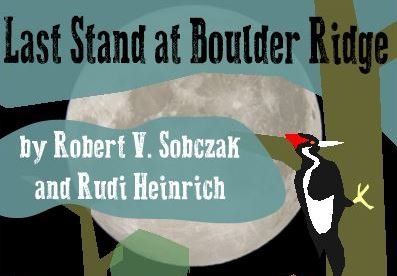
The Centennial Campfire Trilogy by Robert V. Sobczak and Rudi Heinrich consists of three books: (1) The Legend of Campfire Charlie, (2) Last Stand at Boulder Ridge and (3) Final Campfire.
Why do I like most about the book?
To me, it’s a “rereadable” through a through. It’s the type of book you can pick up off your bookshelf and read front to back, or one chapter at a time, or even a few sentences. It is also what I call an immersive read. It takes you across the globe and deep back into time, to the point you can really get lost (in a good way).
As for my favorite scene?
It’s probably the campfire banter between Rusty and Kenny while in the desert overseas. Or maybe it’s Rusty’s airboat ride with his father? Or maybe his boyhood encounter with Edward Abbey? Or maybe it’s the journals of Col. Stanley Powell. Or maybe it’s the Bone Wars era archaeological dinosaur dig. Or maybe it’s even the prologue to the book.
 Bob and Rudi never set out to a book, let alone a trilogy. Their task as hand was much simpler: A 30-minute campfire talk to a dozen or two campers at a remote swamp campground. |