Buy the Books

Looking for three handsome books …

And better yet, an immersive campfire read?

Original Movie Trailer

If so, we highly recommend the Centennial Campfire Trilogy, all three books, either in kindle format or paperback. Personally, we recommend the paperback because for one you’ll be dog-earing many a page, referencing back and forth, and did we mention, they are awfully pretty tomes, either for your coffee table or bookshelf.

Book 1: Legend of Campfire Charlie

Watch the Book Review

Preview Book (click on image to see inside book)

Book Summary

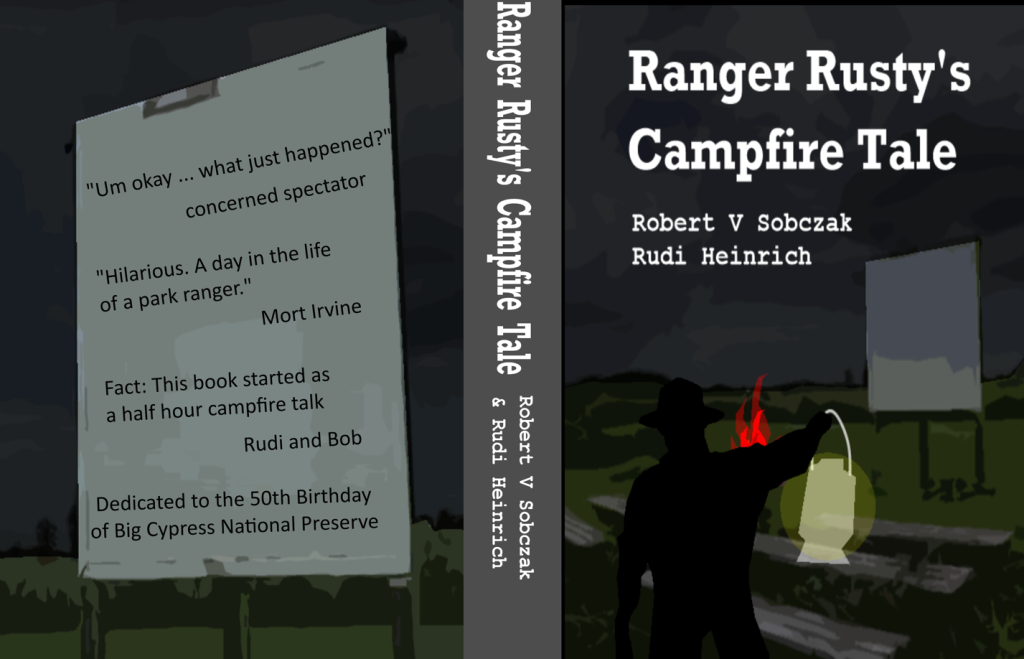
Welcome to Book 1 of the Centennial Campfire Trilogy. Do you have a fear of being squeezed to death by a giant Burmese Python? Or does being followed around all day by a Florida Panther rattle your nerves? If so, join Rusty, a well meaning but – how shall we say – “often distracted” park ranger who is scheduled to give an evening talk in a swamp preserve on a topic he doesn’t much like. Not to worry (or maybe worry a lot) as the unwitting ranger meets a mysterious stranger who catapults him on a breathtaking journey to confront and maybe finally answer the deepest and most confounding question of his life. That is assuming he can ever get done (or to) his campfire talk …

Book 2: Last Stand at Boulder Ridge

Watch the Book Review

Preview Book (click on image to see inside book)

Book Summary

Welcome to Book 2 of the Centennial Campfire Trilogy. The saga continues! This time Ranger Rusty and his cohorts are off on a new adventure that leads them back and forth seamlessly in time and space to faraway places that include a Seminole War fort, the sands of the Middle East, the mountains of the Great Southwest, an archaeological expedition on the Mighty Joola River and airboat rides across the Everglades. Or is it all unfolding around the campfire glow in a remote nature reserve? We’ll let you be the judge.

Book 3: Final Campfire

Watch the Book Review

Preview Book (click on image to see inside book)

Book Summary

Welcome to Book 3 and what critics are raving “the stunning conclusion” to the Centennial Campfire Trilogy. At the end of the first two books of the trilogy — The Legend of Campfire Charlie and Last Stand at Boulder Ridge — our fearless protagonist, Ranger Rusty, finds himself simultaneously trying to man the Sweetwater Visitor Center in the heart of the Big Cypress Swamp while also slipping back in time to distant childhood memories of an old backcountry camp and deeper still to a first-hand historical account of adventures at a Seminole War era fort and a haunted archeological dig for dinosaur bones as he tries to conjure the energy to hold court at a campfire talk in a remote campground at the end of a very (emphasis on very) long day. As exquisite an ending you’ll ever find in a “large canvas” epic work, Final Campfire is a full-body experience that no respectable book reader, plumber or campfire enthusiast (including the inner s’mores roaster in all of us) will want to miss.
It’s a new dawn with Candidate Burt Silver, but only because he stayed up all night to see it

— Burt Silver

Outside the Bunker
And why we hit the road

What’s the best way …

To reach your audience?

Buck hits the road

For AM Radio Host “In The Bunker” with Buck Buckner, the usually means hunkering down in the place he knows best, and where he can broadcast has thoughts far and wide — in the safety and sanctity of his bunker. As for who’s actually listening, even if it’s only one person (and that one person is Buck), it’s worth the cause. Or do you sometimes have to venture outside the comfort zone to reach new crowds? Buck finds himself oddly reenergized as he hits the road.

Buck Buckner is an AM Radio host at Campfire Park.

I don’t know much, but I’m inclined to spill whatever I do out at the campfire

— Old Miner

The campfire is always crackling and visitors are always welcome at Campfire Park

— Cowboy at the Campfire

Power of the bookmark
And why you still need one

Remember the days …

When a bookmark was a good present?

Cowboy talks bookmarks

Well, how else were you going to remember where you left of reading. Sure, you could use a scrap piece of paper, or alternatively dog ear a page, or even try to remember the page you last left off, but none of those had the style points of a good old fashioned bookmark — especially the ones with a tassel on the end. Today, bookmarks are pretty rare. And if you read from your phone or another digital device, really what’s the point. My solution: I highly recommend picking up a “paper and ink” copy of your favorite book (i.e. think of “paper and ink” as the “bricks and mortar” equivalent of a digital book), find a comfortable chair and settle down under a good reading light and just dive into a book. And no you won’t get it done in one sitting. That’s why you’ll need a good bookmark.

Remember the Rule of the Ninja: Never fear, never doubt, and never over think.

— Ranger Rudi

What Weekend?
Not that I'm complaining

Nobody sets out for their weekend to turn into an algorithm, nor do you expect to show up on Monday to discover that your flagship website isn’t working quite like it should.

P.S. Firelight Radio is available on Apple Podcasts and PodbeanAdd block

The positive news is that I went for two runs and three walks and had two eureka moments along the way. I’m not saying I have things completely figured out. But by the end of Monday, I turned the lemons of having to revert to a “backup(p)ed” version (I can’t seem to spell that word) of my website only to serve as inspiration to reformat the entire front page. After about two hours I finally got it to looking semi-right. In retrospect, I’m not convinced the breakdown wasn’t a blessing in disguise. It forced me to admit that the old formatting wasn’t quite working.

But my larger point: Really, the whole point about the Nature Folk Flyer is to connect myself and my audience to nature. Why is it then that I seem to be spending equal shares of my time working through the minutia and archania of the computer matrix? It didn’t help that the internet was down when I arrived home at the end of the day. Keep in mind by this time I had discovered that my website was seizing up, and entire pages weren’t appearing when clicked. After a quick inspect of a couple work-arounds, and a hesitancy to try to contact technical support which is always by chat, and not very good: I simply took the bull by the horns and reverted to a backup copy of my site. And as I said, that served as inspiration to reformat and reconsider my old structural design.

The result? I’d really like to delve deeply into the Nature Folk Movement (NFM), and maybe someday I’ll get this complex architecture of websites figured out. Until then, I’m just glad I’m enjoying the process. What more really can you ask for in life?

Try not to overthink a song. Go with what pops in your head, run with it, and don’t stop until you cross the finish line.

— Bobby Angel

Steephead Valleys
And why they are "spring like"

Steephead valleys aren’t as famous …

Or as charismatic as a Florida spring.

Steephead valleys have a distinctive rounded shape

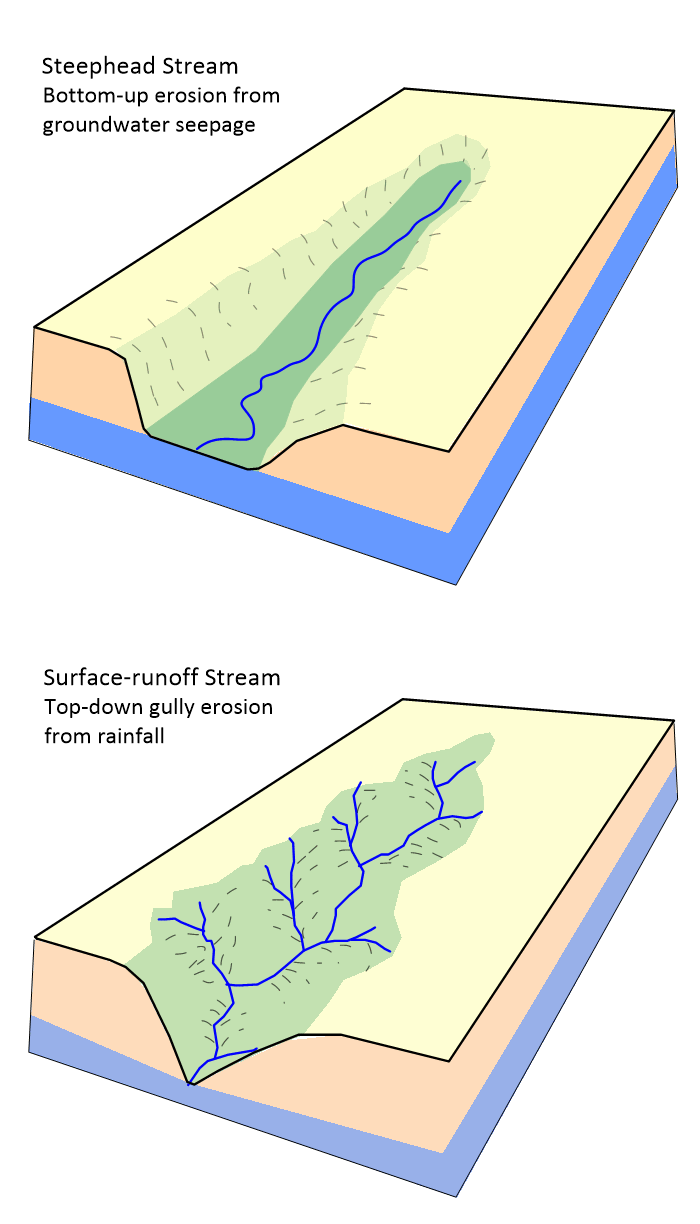
But they are similar in they are both groundwater fed. Unlike springs that appear in full force out of nowhere, emerging from a cavernous hold in the ground in the form of a “boil,” steephead streams are smaller in scale and at their upstream end pinch back to a vanishing point. And unlike a gully-eroded dendritic (i.e. branching) stream channel that depends on rainwater for its source, and accordingly erodes from top-to-bottom — a steephead valley contains a single stream that depends on groundwater seepage as its source. Grain by grain, that causes erosion to occur from the bottom-up, giving the ravines their trademark rounded and slumping shape. Another key difference: The gradient between its headwater and mouth are low.

What makes steepheads special? The steady flow and constant (cooler) temperature makes both the ravines and the streams home to endemic and rare northern plants. An endangered fish called the Okaloosa darter is only found in steephead streams. As for their location, they are found in isolated patches in the panhandle where the regional groundwater table and alluvial floodplain intercept.

Well howdy folks, and I’m completely freaked out. And you know why. The fringe middle. The silent majority. Why are they so quiet?

— Buck Buckner

Dinosaur interviews himself
What a wonderful guest!

What’s the secret …

To a good interview?

Rare interview with an even rarer dinosaur

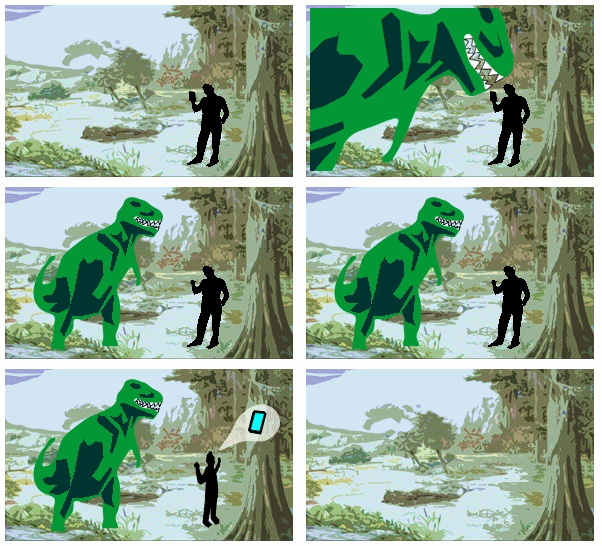
Some would say ample research on the topic you’re trying to discuss.  Others would say having a good set of questions.  Still others would say inviting in a good guest.  But for me, the secret to a good interview starts with the host.  It isn’t so much the questions or the answers as it is the good conversation to be had.  And really, for that to occur: Is there really a need for anyone else?  Answer: I would say yes.  The caveat is you better be comfortable having a dialog with yourself first.  And that’s why in many ways this is a breakthrough interview. 

Among the topics we cover:  My new idea for a great app, new details on the Time of Great Phonelessness (i.e. Before Phones), how phones stole our memories, the difference between prescient and clairvoyant, why a ranger kept returning to the swamp and what made him stop, the difference between a tree and a large blade of grass, why cigarettes are healthier than cell phones, how banjos went viral, and more.