Nature

There’s no better way to promote phonelessness than by reconnecting with nature. | Before Phones Movement | Our supporters | Our adversaries | Main campfire

The Green Album
Like the White Album, but green

Is there anything harder …

Than following up a hit opening act?

Listen to The Green Album

After an intense and prolonged period of songwriting – often deep in nature, in areas that have yet to be mapped, and sometimes but not always by a campfire – I am finally nearing completion of my second studio album. It’s theme? Much like my first album New Pangaea it strikes deep in the heart of what the Before Phones Movement (BPM) is all about.

Unlike New Pangaea, my second album takes on thornier topics that many other songwriters would shun due to their complexity and controversial nature. For example, with The Lusitania, I believe I official and forever knock the Titanic (including the movie, and quite possibly the soundtrack – although I’d love to collaborate with Celine Dion) off the top spot and elevate the sinking of the Lusitania as the most tragic and memorable maritime disaster of the past 200 years. Why? Because it’s also an antiwar protest song. Even more subtly, another song on the album – Old Jim Dill – recounts the personal devastation wrought by the Great War, also know as the War To End All Wars, or just WWI and how he, at least partly, overcame it by finding comfort in a nature retreat.

But I digress …

Tentatively, in our studio sessions, we’ve been referring to the album as simply “The Green Album,” although that may yet change. Other names being batted around include PreservedThe Blue Album (long story), Green on Green, and To All My Fans, With Love, Bobby Angel.

People often ask me: “Bobby Angel, what’s your favorite thing about your second album?” My answer is always and unequivocally the same:

Performing the songs to connect their meaning to others. And also, I must admit. I’m kind of itching to do a third album. So it feels good have the second one done, or almost done. As much as I’m an “ad hoc go with the flow” type of guy, I’m equal parts a finisher, too. That’s my secret to songwriting. Get it done and then move on. The longer a song sits the more it starts to lose its original intent. Songs in their truest form capture a moment and just flow.

Bobby Angel

A “moment catcher” is what a good song is.

At least that’s my theory (for now).

Remember the Rule of the Ninja: Never fear, never doubt, and never over think.

— Ranger Rudi

Redemptive Return
A prodigal son returns to get things right

Restoration is possible …

You just have to believe.

Prodigal son returns with a campfire confession

A little imagination doesn’t hurt either …

Plus a lot of hard work.

The list goes on.

Or is it too late? In this campfire confession, a prodigal son returns to to find a landscape he doesn’t remember and memory he wants to reclaim. Fortunately the Cowboy at the Campfire has a fire waiting and is ready to hear him out.

Share with friends

Quote: “Redemption is not perfection. The redeemed must realize their imperfections.” — John Piper

The campfire is always crackling and visitors are always welcome at Campfire Park

— Cowboy at the Campfire

Original Gate
A short history of water management

There was a time when the water just flowed …

Unfettered, free and without a thought.

A parable of a water manager, at night, with regrets

And then we built the original gate. And one more after that, and then another and another until there were too many to count. Granted, nothing is more complicated than water management. But let’s also face the facts: We brought it on ourselves.

And now the question: Can we still fix it to get it right? Or is it too late. In this short video, a confident water manager wavers with a moment of doubt, and a confession, in the middle of the night. The good news: The Cowboy at the Campfire was waiting.

Share post with friends

Quote: “When the well is dry, we know the worth of water.” — Benjamin Franklin

It’s a new dawn with Candidate Burt Silver, but only because he stayed up all night to see it

— Burt Silver

Major Water Speech

When is it a good time …

To talk about water?

Burt’s water speech

Answer: Probably at any point during a campaign, or after it for that matter, too. To quote a close friend, water will always be on humanity’s Top 3 priority list. Family, peace, water. Maybe not in that order. In this epic speech, in true Burt fashion the candidate lays bare his passion for the substance at the same time he isn’t going to reveal his hand as to what may or may not be in his cup when he’s playing high stakes poker in the smokey boiler room at night. Why? If Burt understands anything in life, it’s how to play a hand, be it weak or strong. In his view, him revealing whether he’s drinking water or something else is akin to the most dreaded of card table (and/or negotiation) faux paus — a tell.

So you’ll just have to trust Burt when in comes to the water, or whatever’s he drinking.

I don’t know much, but I’m inclined to spill whatever I do out at the campfire

— Old Miner

Steephead Valleys
And why they are "spring like"

Steephead valleys aren’t as famous …

Or as charismatic as a Florida spring.

Steephead valleys have a distinctive rounded shape

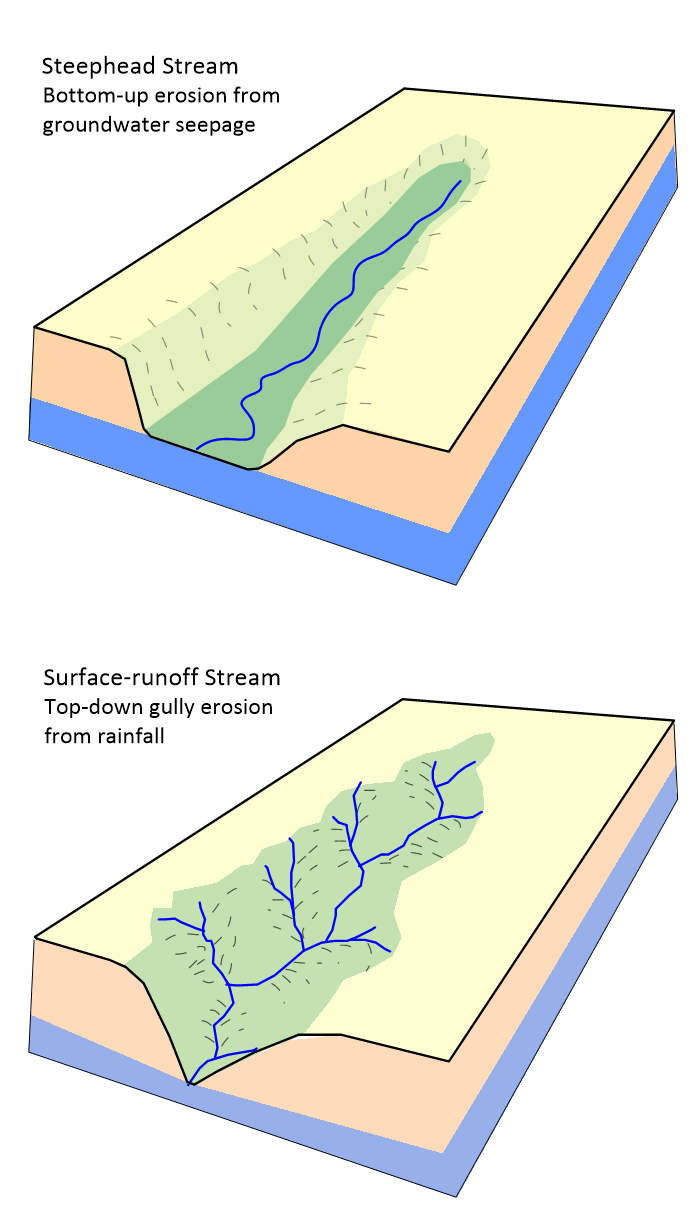
But they are similar in they are both groundwater fed. Unlike springs that appear in full force out of nowhere, emerging from a cavernous hold in the ground in the form of a “boil,” steephead streams are smaller in scale and at their upstream end pinch back to a vanishing point. And unlike a gully-eroded dendritic (i.e. branching) stream channel that depends on rainwater for its source, and accordingly erodes from top-to-bottom — a steephead valley contains a single stream that depends on groundwater seepage as its source. Grain by grain, that causes erosion to occur from the bottom-up, giving the ravines their trademark rounded and slumping shape. Another key difference: The gradient between its headwater and mouth are low.

What makes steepheads special? The steady flow and constant (cooler) temperature makes both the ravines and the streams home to endemic and rare northern plants. An endangered fish called the Okaloosa darter is only found in steephead streams. As for their location, they are found in isolated patches in the panhandle where the regional groundwater table and alluvial floodplain intercept.

Try not to overthink a song. Go with what pops in your head, run with it, and don’t stop until you cross the finish line.

— Bobby Angel

Spring drought paradox

There’s no lusher drought …

Than springtime in the Big Cypress Swamp.

This podcast dives deep into the paradox and oxymoron of south Florida’s spring drought, why you should never walk into a gator hole, and when we can expect it to end with the start up of the summer rains.

Well howdy folks, and I’m completely freaked out. And you know why. The fringe middle. The silent majority. Why are they so quiet?

— Buck Buckner

Waterman Speech
Coming to a train station near you

What does it take …

To protect our water resources?

Water needs vision like never before

In word, vision. But vision alone is not enough. It requires activism and a willingness (and energy) to deliver the message to the people in their communities and in a way that communicates to their hearts and their minds. Lastly, it takes a sustained effort and getting everyone involved.

More about this speech: I wrote it in a fit of inspiration meant to be delivered in front of the campfire. It borrows heavily from other speeches, but also tries to cultivate its own organic voice and tenor. Importantly, I memorized the speech before actually putting it to paper. It was only in performing it, and listening to myself say it, that I refined the language and intonations, the later of which continue to evolve. There is a prequel to this speech. Maybe I have to starting thinking of a second part, too. BTW: I do have a powerpoint I often lead into after the speak, called “The Water Plan.” Vision is vital but persistence (and executing the plan) is the ultimate cure.