Go Hydrology

Looking to reconnect with nature the smart way? The Savvy outsider helps you become an insider to the wonderful world just outside your door. | Before Phones Movement | Our supporters | Our adversaries | Main campfire
Steephead Valleys
And why they are "spring like"

Steephead valleys aren’t as famous …

Or as charismatic as a Florida spring.
Steephead valleys have a distinctive rounded shape

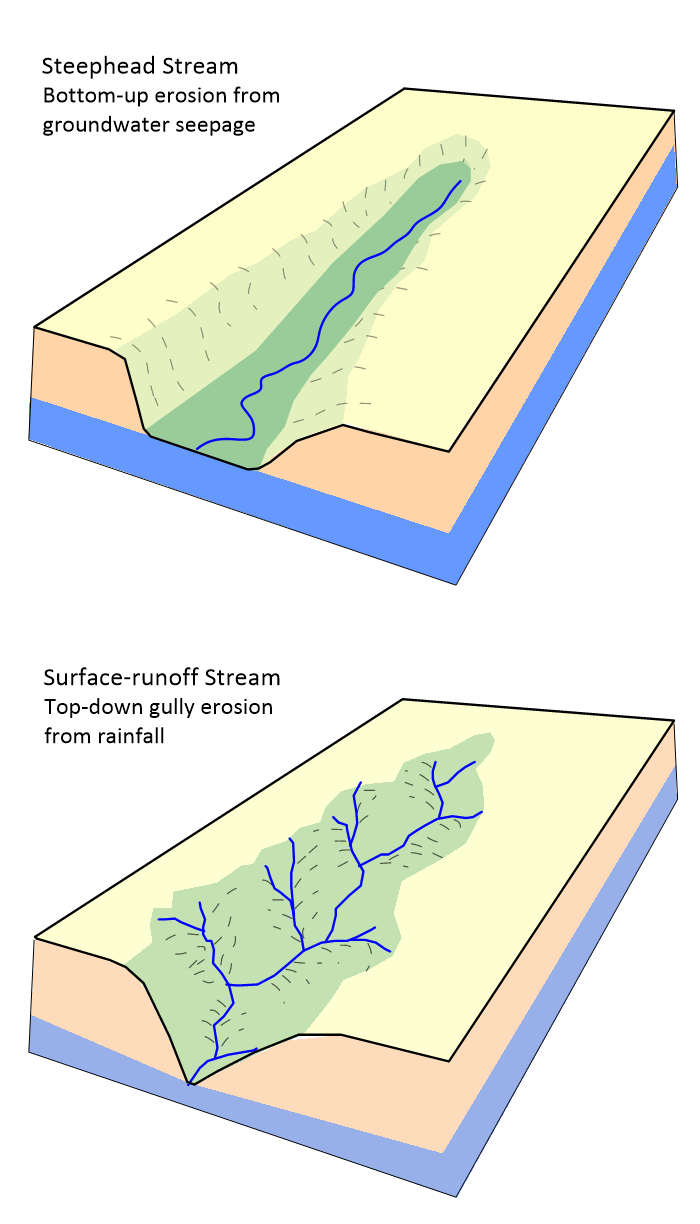
But they are similar in they are both groundwater fed. Unlike springs that appear in full force out of nowhere, emerging from a cavernous hold in the ground in the form of a “boil,” steephead streams are smaller in scale and at their upstream end pinch back to a vanishing point. And unlike a gully-eroded dendritic (i.e. branching) stream channel that depends on rainwater for its source, and accordingly erodes from top-to-bottom — a steephead valley contains a single stream that depends on groundwater seepage as its source. Grain by grain, that causes erosion to occur from the bottom-up, giving the ravines their trademark rounded and slumping shape. Another key difference: The gradient between its headwater and mouth are low.

What makes steepheads special? The steady flow and constant (cooler) temperature makes both the ravines and the streams home to endemic and rare northern plants. An endangered fish called the Okaloosa darter is only found in steephead streams. As for their location, they are found in isolated patches in the panhandle where the regional groundwater table and alluvial floodplain intercept.
It’s a new dawn with Candidate Burt Silver, but only because he stayed up all night to see it

— Burt Silver

Spring drought paradox

There’s no lusher drought …

Than springtime in the Big Cypress Swamp.

This podcast dives deep into the paradox and oxymoron of south Florida’s spring drought, why you should never walk into a gator hole, and when we can expect it to end with the start up of the summer rains.

I don’t know much, but I’m inclined to spill whatever I do out at the campfire

— Old Miner

Waterman Speech
Coming to a train station near you

What does it take …

To protect our water resources?

Water needs vision like never before

In word, vision. But vision alone is not enough. It requires activism and a willingness (and energy) to deliver the message to the people in their communities and in a way that communicates to their hearts and their minds. Lastly, it takes a sustained effort and getting everyone involved.

More about this speech: I wrote it in a fit of inspiration meant to be delivered in front of the campfire. It borrows heavily from other speeches, but also tries to cultivate its own organic voice and tenor. Importantly, I memorized the speech before actually putting it to paper. It was only in performing it, and listening to myself say it, that I refined the language and intonations, the later of which continue to evolve. There is a prequel to this speech. Maybe I have to starting thinking of a second part, too. BTW: I do have a powerpoint I often lead into after the speak, called “The Water Plan.” Vision is vital but persistence (and executing the plan) is the ultimate cure.

Try not to overthink a song. Go with what pops in your head, run with it, and don’t stop until you cross the finish line.

— Bobby Angel
podcast

Talking Tree
Firelight Radio presents

Welcome to Firelight Radio …

Where we tune in to the Nature Folk Movement (NFM).

Firelight Radio is available on Apple Podcasts and Podbean

What exactly is the NFM? It’s the feeling that wells up into our hearts and minds when we gather around a campfire — the crackle, the glow, the aroma and the strumming. Here at Firelight Radio, we’re campfire inspired and guitar guaranteed. You’re always gonna hear a little crackling and you’re always gonna a little strumming. It’s where we get back to what’s important in life.

On today’s episode, we talk to a tree.

Actually, it’s the tree that does most of the talking.

Well howdy folks, and I’m completely freaked out. And you know why. The fringe middle. The silent majority. Why are they so quiet?

— Buck Buckner